


Argentinean Court Backs Anti-Protest Protocol
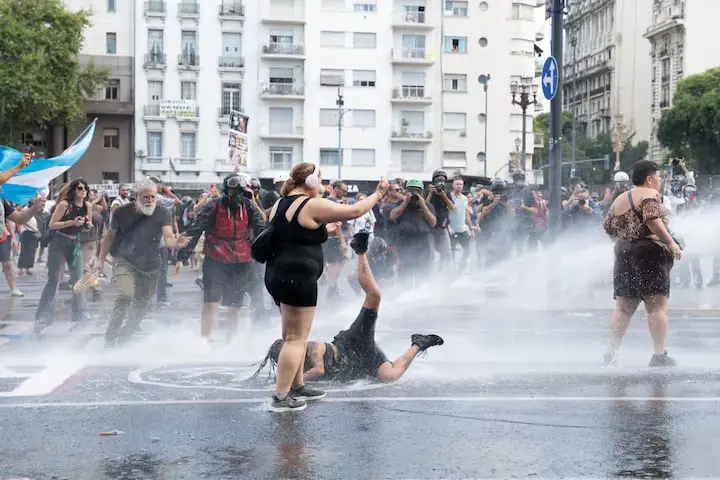
(FILE) The implementation of this protocol has left hundreds of people injured, including press workers, and numerous arbitrary arrests during mobilizations against Milei’s policies. Photo: Alejandra Morasano.
March 31, 2026 Hour: 10:49 pm
🔗 Comparte este artículo
Argentina’s judiciary on March 31 has reinstated the controversial anti-picket protocol, empowering the Milei’s Government to maintain repressive deployment of federal forces against protests.
The Argentine Federal Administrative Litigation Chamber’s recent decision has unequivocally re-established the contentious “anti-picket protocol“, a measure championed by former Security Minister Patricia Bullrich.
This significant judicial reversal effectively overrides a first-instance ruling that had previously declared the protocol unconstitutional, underscoring a concerning shift in the balance between state power and civil liberties.
The initial judicial assessment had thoughtfully argued that the involvement of federal forces in managing public demonstrations should be strictly exceptional, rather than becoming the accepted rule. However, the new resolution from the appellate court has now explicitly enabled Javier Milei’s Government to sustain its repressive deployment tactics, justifying such actions by citing the imperative to guarantee “free circulation” across the nation’s federal territories, thus intensifying the debate over the right to protest in a democratic society.
This decisive ratification means that the protocol will be applied immediately and systematically in response to any road blockades or public manifestations occurring on federal land.
This move marks a critical juncture for Argentina’s democratic framework, as it potentially curtails the fundamental right to protest, a cornerstone of free expression and democratic participation.
Human Rights organizations and various social movements have consistently condemned the protocol, arguing that its core purpose is to criminalize social protest and grant disproportionate authority to security forces. The government’s rationale, centered on “free circulation”, is viewed by critics as a pretext to suppress legitimate dissent and to target those who challenge the administration’s policies, further exacerbating social tensions and undermining the ability of citizens to collectively voice their grievances without fear of immediate state repression.
The first-instance ruling, which had offered a brief reprieve to protest groups, highlighted profound legal and constitutional concerns regarding the protocol’s legality. It had meticulously detailed how the measure infringed upon constitutional rights and contradicted international human rights treaties to which Argentina is a signatory. By overturning this decision, the Federal Administrative Litigation Chamber has, in essence, provided judicial sanction for a policy that critics argue enables arbitrary detentions, facilitates police abuses, and risks the use of excessive force.
Author: Laura V. Mor
Source: Pagina 12/ Agencies